
Our editorial team follows strict guidelines to ensure accuracy and objectivity. Learn more about our process.
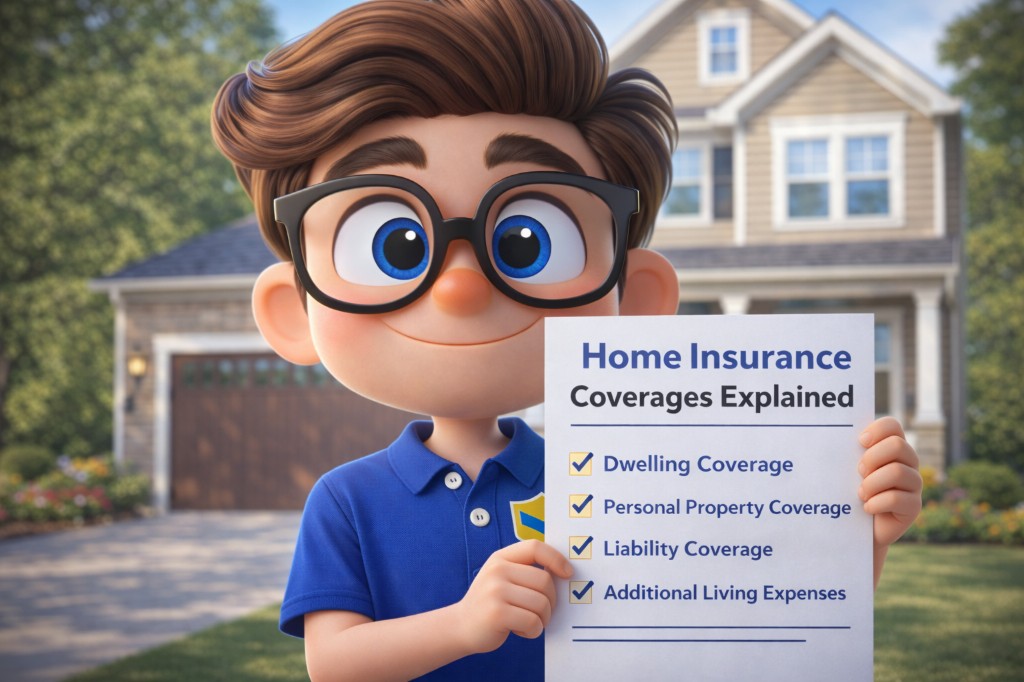
Standard homeowners insurance protects your dwelling, personal property, liability, and additional living expenses after a covered loss. You also need to know what’s excluded (floods, earthquakes, wear and tear) and how limits and perils work.
This guide summarizes each coverage type, links to deep dives, and shows how to choose amounts—without repeating what’s on your individual coverage pages.
What Does Home Insurance Cover?
Most policies bundle property, belongings, liability, and living expenses:
- Dwelling and other structures – Your home’s structure, plus detached garages, fences, etc., up to policy limits
- Personal property – Furniture, clothes, electronics, and more—often 50–70% of dwelling; sublimits apply to jewelry, guns, etc.
- Personal liability – Injuries or property damage you’re legally responsible for; defense costs included
- Loss of use – Hotel, meals, and extra costs if you can’t live at home during a covered repair
Policies list covered perils (or use “open peril” for the dwelling). See what’s typically covered on our home insurance perils page →
Key Takeaways
- Standard policies include dwelling (A), personal property (C), loss of use (D), and liability (E); many also include other structures (B) and medical payments to others (F)
- Named-peril or open-peril wording determines what’s covered (explained on the perils page linked above)
- Replacement cost vs actual cash value affects how much you get for property claims—details in Personal property below
- Floods and earthquakes need separate coverage; endorsements can fill gaps like water backup or high-value items
- Review limits after renovations or big purchases
Coverage Types Explained
Dwelling coverage (Coverage A)
Covers the house and attached structures (e.g. garage, deck) for damage from covered perils. Insure for replacement cost to rebuild—not market value. Learn more about dwelling coverage →
Personal property (Coverage C)
Covers belongings at home and often away from home; high-value categories have sublimits. Choose replacement cost when you can. For how claims are paid, read ACV vs replacement cost →. Learn more about personal property →
Loss of use (Coverage D)
Pays extra living costs (hotel, meals over normal) if your home is uninhabitable after a covered loss—often about 20% of dwelling limit, with time caps. Learn more about loss of use →
Personal liability (Coverage E)
Covers bodily injury and property damage you’re liable for, plus legal defense. Many carriers recommend $300,000+; umbrella policies add more. Learn more about liability →
What’s Not Covered
Floods – Not covered by standard homeowners; use NFIP or private flood insurance.
Earthquakes – Excluded; buy a separate policy or endorsement where available.
Wear and tear – Gradual issues (old roof, long-term leaks, pests) aren’t covered—maintenance is on you.
Sewer backup – Often excluded unless you add a water backup endorsement.
Expert Insight: When one loss hits several coverages
Brianna's house had a kitchen fire. Her dwelling coverage paid to repair structural damage, personal property paid to replace cabinets and belongings, and loss of use helped with hotel costs while the home was uninhabitable—three coverages, one coordinated claim.
—Brianna Baiocco
How to Choose the Right Coverage
- Dwelling – Base limit on 100% replacement cost; ask about extended/guaranteed replacement if offered
- Personal property – Do a home inventory; schedule jewelry/art if above sublimits
- Liability – Match assets and risk (pool, trampoline, dog); consider an umbrella policy
- Deductibles – Higher deductible lowers premium but raises out-of-pocket at claim time
- Endorsements – Add water backup, scheduled property, or home business coverage if needed; when shopping for home insurance, compare apples to apples
Choosing the Right Coverage Amounts
Use replacement cost for dwelling; align personal property with inventory; carry liability that reflects net worth and hazards. The table below is a starting point—your agent can tailor limits.
| Coverage Type | Basic | Recommended | Stronger protection |
|---|---|---|---|
| Dwelling | 100% replacement cost | Extended replacement (e.g. 125%) | Guaranteed replacement (if offered) |
| Personal property | 50% of dwelling (ACV) | 70% of dwelling (RCV) | 70%+ with scheduled items |
| Liability | $100,000 | $300,000 | $500,000+ plus umbrella |
| Loss of use | ~20% of dwelling | ~30% of dwelling | Longer time / higher % if available |
More detail lives on our homeowners insurance hub.
Tools & savings
Ballpark your premium and limits with our home insurance calculator. Combining home with auto or other lines often saves money—see bundle insurance.
Most gaps in homeowners coverage — an underinsured dwelling limit, ACV contents when RCV is what you need, a liability limit that doesn't match your asset exposure — aren't visible until a claim. As a licensed independent agency, we review all five coverage layers against your actual home, belongings, and risk profile, not just the defaults your carrier set at issue.
Don't have time to run a quote? Just send us your policy
Share your current policy declarations pages with us in two clicks. Takes about 30 seconds. We'll review your coverage, find gaps, and compare our carriers to your current policy.
Connect your policy
FAQ
About Brad Cummins

Brad Cummins is the founder of Insurance Geek and primary author of its educational content. Licensed since 2004, he brings over 21 years of experience structuring life insurance and IUL strategies for clients nationwide.
Fact checked by Brianna Baiocco

Brianna Baiocco runs P&C operations at Insurance Geek and fact-checks property and casualty content. Licensed since 2009, she brings over 16 years of experience in auto, home, renters, and commercial insurance.