

Our editorial team follows strict guidelines to ensure accuracy and objectivity. Learn more about our process.
You've probably seen the headlines: Elon Musk borrowed $13 billion against his Tesla shares. Jeff Bezos used his Amazon stock as collateral for a $25 million home loan. Neither sold a share. Neither paid a dollar in capital gains tax.
That's buy, borrow, die — a legal tax strategy that lets the wealthy access the value of their assets without ever triggering a taxable sale. The asset keeps growing. The loan isn't income. And at death, the tax bill disappears entirely.
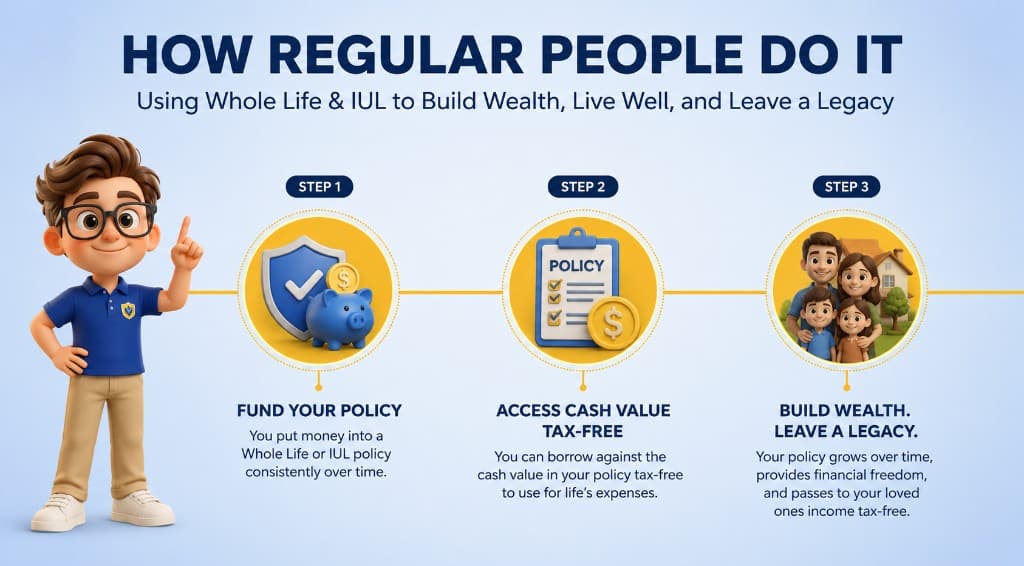
Most articles stop there and leave you thinking this only works if you own $500 million in stock. But there's a version of this strategy built specifically for families and working professionals — and it runs through whole life insurance with paid-up additions, or an IUL. Same concept. Different vehicle. No margin calls. No $1 million brokerage account required.
What Is Buy, Borrow, Die?
Buy, borrow, die was coined by USC law professor Edward McCaffery in the 1990s to explain how wealthy families legally avoid taxes across generations. The insight is simple: the IRS taxes income and realized gains — but not borrowing, and not appreciation you never sell.
| Phase | What You Do | Tax Event |
|---|---|---|
| Buy | Purchase an appreciating asset — stock, real estate, or a whole life / IUL policy with paid-up additions | None |
| Borrow | Take a loan against the asset's growing value to fund your lifestyle or retirement income | None — loan proceeds are not taxable income |
| Die | Asset transfers to heirs; the death benefit or stepped-up basis eliminates the accumulated tax liability | None |
The result: a lifetime of tax-free access to wealth, followed by a tax-free transfer to the next generation.
The Calculator: Sell vs. Borrow
Plug in your numbers to see what you'd owe selling or surrendering an asset versus what borrowing actually costs.
Two Ways to Do It
Most people searching this topic are thinking about the billionaire version — borrowing against a stock portfolio. That version exists and it works, but it comes with real risks and high minimums. The insurance version solves both problems.
| Stock / Real Estate Version | Whole Life / IUL Version | |
|---|---|---|
| The asset | Appreciated stocks, real estate, private equity | Cash value inside a whole life or IUL policy |
| How you borrow | Securities-backed line of credit, HELOC, margin loan | Policy loan — no bank, no credit check, no application |
| Minimum to start | $500K–$1M+ in liquid assets | $500–$2,000/month in premiums |
| Risk of forced sale | Yes — margin calls if asset value drops | No — policy loans can never trigger a forced sale |
| Death benefit | None | Yes — passes to heirs income tax-free |
| Who it's for | High-net-worth investors | Families building long-term tax-free wealth |
The insurance version is built around IRC §7702 — the IRS code section governing life insurance taxation. Cash value grows tax-deferred, loans come out tax-free, and the death benefit transfers to heirs income-tax-free regardless of what happens to the step-up in basis rule. That last point matters: the stock version depends on Congress leaving the stepped-up basis intact. The insurance version doesn't.
Why This Belongs in Your Retirement Plan
Buy, borrow, die isn't just a wealth transfer play — it's a retirement income strategy. Policy loans in retirement don't count as taxable income. That means they don't:
- Trigger taxation on your Social Security benefits
- Count toward Medicare IRMAA surcharge thresholds
- Affect your Roth conversion math
- Create required minimum distributions
Most retirement strategies — 401(k)s, IRAs, even brokerage accounts — create taxable income when you access them. A properly structured whole life or IUL policy doesn't. That's the same reason we talk about LIRPs, the Rich Man's Roth, and TFRAs in this hub — they all use the same underlying tax treatment to create income that lives outside the IRS's reach in retirement.
Expert Tip: The insurance version removes the biggest risks of the stock version
With a securities-backed line of credit, a 30% market drop can trigger a margin call — forcing you to sell the exact asset you were trying to hold. With a whole life policy loan, there is no collateral call. The cash value is the collateral, and the policy itself guarantees the loan can't be called due to market conditions. That structural difference is what makes the insurance version practical for families, not just hedge fund managers.
—Brad Cummins, Insurance Geek Founder
Risks to Know
| Risk | Stock Version | Insurance Version |
|---|---|---|
| Margin / collateral call | Yes — if asset value drops sharply | No |
| Rising interest rates increase loan cost | Yes — rates on SBLOCs are variable | Partially — policy loan rates are typically fixed or capped |
| Step-up in basis eliminated by Congress | Yes — would undermine the "die" phase | No — death benefit is tax-free under a separate IRC provision |
| Asset value drops below loan balance | Yes — lender can demand repayment | Rare — cash value growth is more stable; policy won't lapse if structured correctly |
| Long time horizon required | Moderate | Yes — whole life needs 15–20+ years to perform well |
Is This Right for You?
The insurance version of buy, borrow, die works best if:
- You're in the 24% tax bracket or higher and expect that to continue in retirement
- You have a 15–20 year runway before you need income from the policy
- You're already maxing out your 401(k) and Roth and looking for what's next
- You want tax-free retirement income that doesn't affect Social Security or Medicare costs
- You want a death benefit alongside the tax strategy — not just an investment
It's not the right fit if you need the money in the next five years or if you're still getting the basics of retirement savings in place. The foundation comes first.
See a Custom Buy, Borrow, Die Policy Designed for Your Access Needs
Borrowing against cash value can fund retirement without selling assets or triggering income tax—but only if the policy is custom-built for loan access, not just death benefit. Carrier choice, funding pace, and COI structure determine whether loans stay safe or become a lapse risk. See what a properly designed policy looks like for your situation.
Frequently Asked Questions
About Brad Cummins

Brad Cummins is the founder of Insurance Geek and primary author of its educational content. Licensed since 2004, he brings over 21 years of experience structuring life insurance and IUL strategies for clients nationwide.
Fact checked by Ryan Wood

Ryan Wood is a licensed insurance professional and contributing advisor at Insurance Geek, serving as a fact checker and technical reviewer for life insurance and annuity content. First licensed in 2013, he brings more than 12 years of experience and holds licenses in over 40 U.S. states.