

Our editorial team follows strict guidelines to ensure accuracy and objectivity. Learn more about our process.
A kids IUL is an indexed universal life policy on a child. The point is decades of cash value growth and insurability locked in before a health problem can raise the price or end it. Insurance Geek runs that design for parents and grandparents: premium, death benefit, and how the policy stays out of modified endowment contract status. Brad Cummins's own Allianz policies, and the index credits he locked in March 2026, are at the end.
Key Takeaways
Insurability. A kids IUL locks coverage in while the child is healthy. A later diagnosis cannot reprice a policy that is already in force.
Time. A policy started at age 5 or 8 has about 60 years of compounding before age 65. An adult cannot buy those years back.
Not a 529. Cash value can be borrowed for college, a home, or a business. It is not limited to education, and a policy loan is not taxable income while the policy stays in force.
The floor. A down index year credits zero. It does not credit a loss. Policy charges can still reduce cash value.
What Is a Kids IUL?
A kids IUL is permanent life insurance on a child, owned by a parent or grandparent. Cash value is credited from an index, such as the S&P 500 or a blended index, up to a cap, with a 0% floor on the index credit. A down index year credits zero. It does not credit a loss. Policy charges can still reduce cash value.
The child is the insured. The owner controls the policy and can transfer it later. Premiums are often paid for about 20 years. After that, the policy is designed to continue on its cash value, which only works if the funding was actually completed. A policy started at age 5 or 8 has roughly 60 years before age 65. That span is why the cash value figures get large. Other ages and premiums are on the IUL case studies page.
Why Start an IUL for Your Child
Lock in insurability
Once the policy is issued, the coverage stays as long as the policy stays in force. Diabetes, cancer, or heart disease later cannot reprice it. You cannot go back and buy the same policy after a diagnosis. Skipping it means betting that the child will still be insurable when you decide to apply.
Access that is not tied to college
A 529 is for education. A retirement account penalizes early withdrawals. A kids IUL lets the child borrow against cash value at any age, for college, a home, or a business. The loan is not taxable income while the policy stays in force. If the policy lapses with a loan outstanding, that loan can become taxable.
Illustrated retirement income
Left alone until retirement, the same policy can pay income through loans. The income on this page is illustrated, not promised. It is also one reason to fund the policy on purpose. A policy that is started and then starved of premium does not produce those figures.
Kids IUL vs a Roth, 529, or UGMA
A Roth, a 529, and a UGMA each solve one job. A kids IUL is a different job: cash value on a child who has no earned income, with a death benefit that stays in force.
- Roth IRA: Tax-free growth, but the child needs earned income to contribute. A 5-year-old and an 8-year-old do not have a W-2. See IUL vs Roth IRA.
- 529: A state tax deduction in some states, and tax-free withdrawals for education. Non-qualified withdrawals are taxable and may be penalized. See 529 vs IUL.
- UGMA: The account becomes the child's at 18 or 21, and gains are taxable. See IUL vs UGMA.
- Kids IUL: Premiums are paid with after-tax dollars. Growth is tax-deferred. Access is by policy loan, which is not income while the policy stays in force. There is no earned-income test and no education-only rule. How loans are taxed is on the IUL tax benefits page.
The 0% floor is on the index credit, not on the policy itself. A market account can lose principal. An IUL index credit does not go below zero. Charges still come out, and quitting the premium early can stall the policy.
My Kids' Policies: Real Numbers
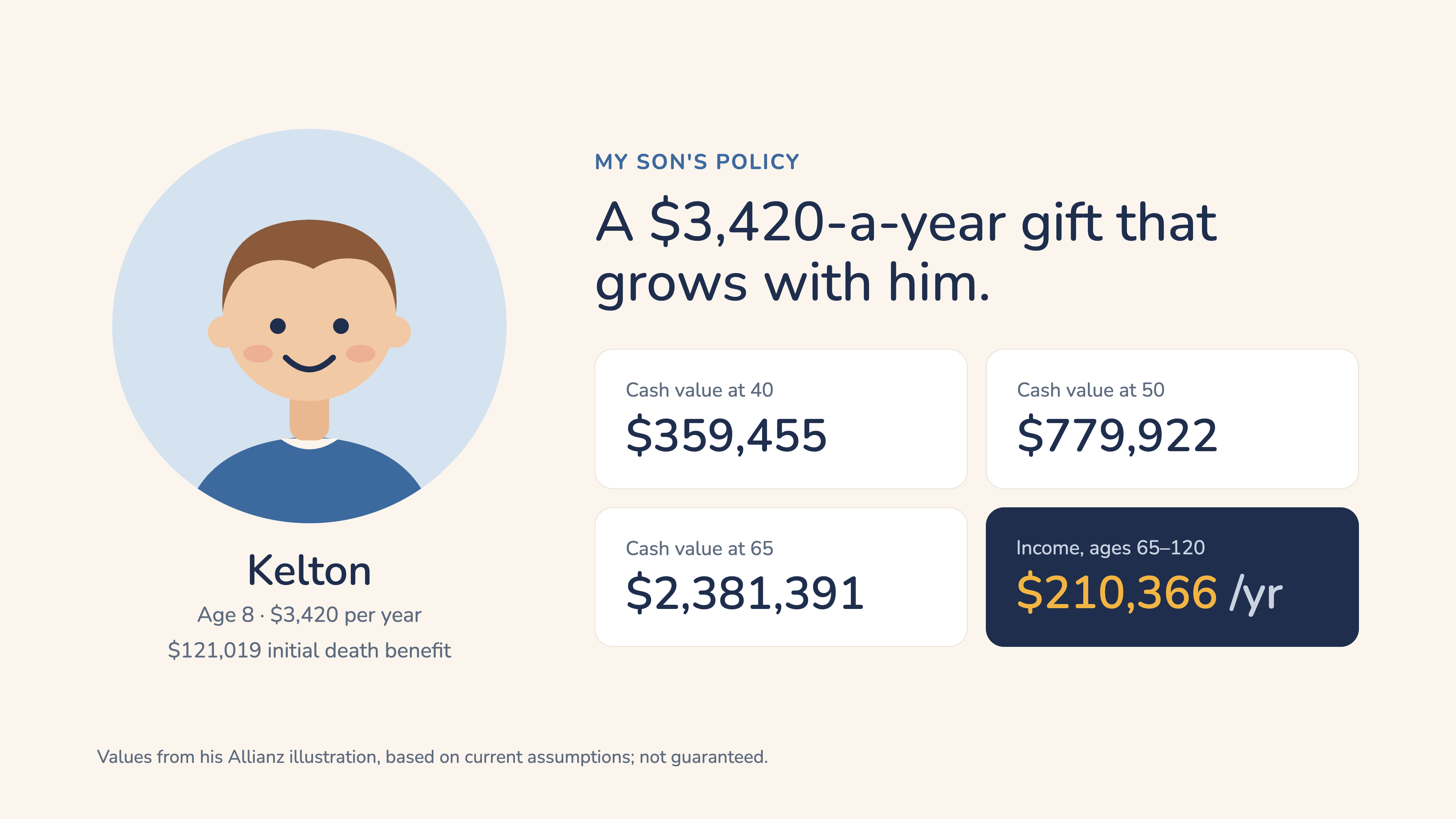
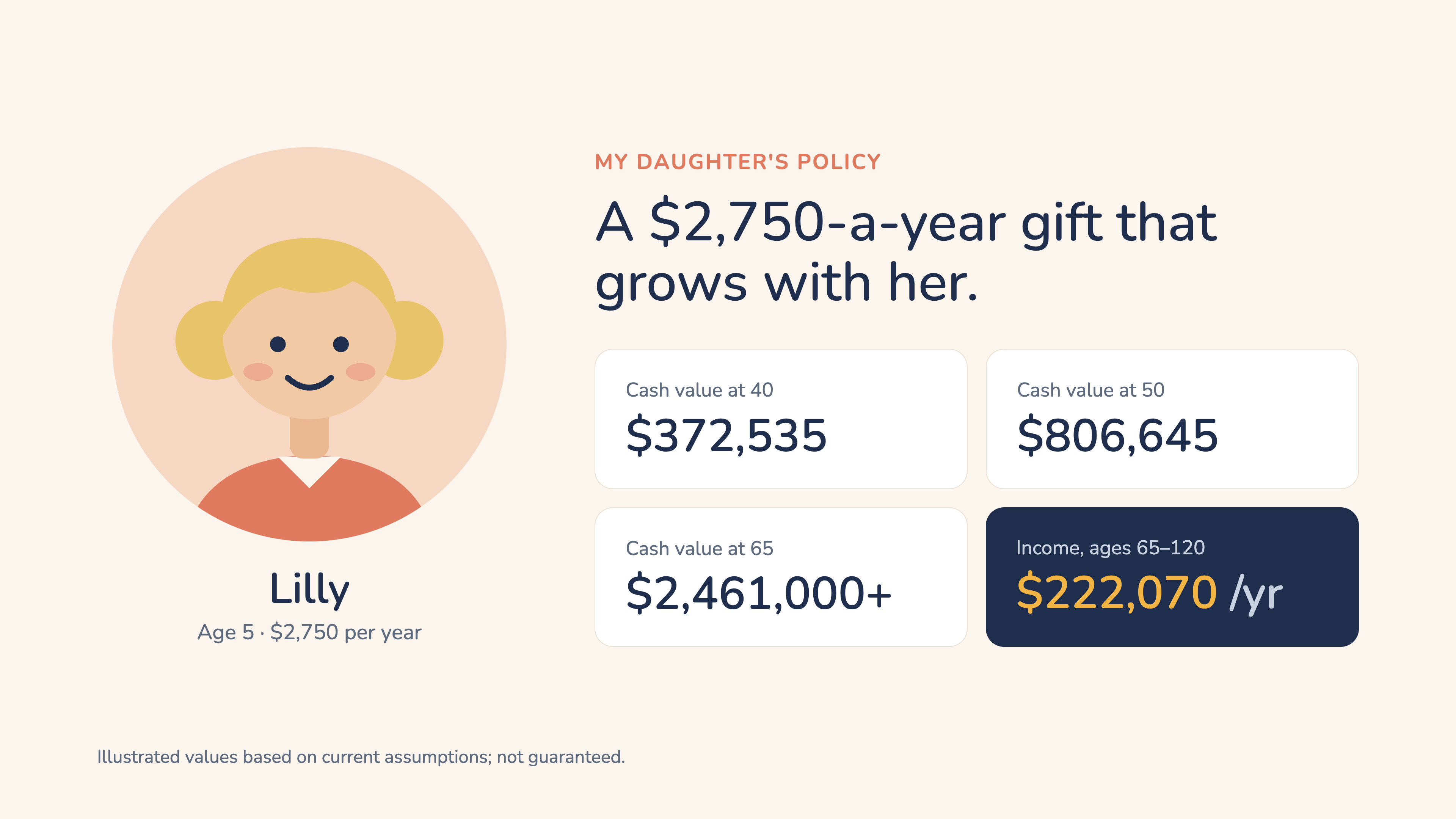
Both of my children have Allianz IUL policies. My son's started at age 8. My daughter's started at age 5. She is younger and female, so the cost of insurance is lower. I fund her policy at a lower premium and still target similar illustrated income. Both illustrations use a 6.65% assumed rate. The March 2026 credits below are higher than that assumption. They are one year, not a promise that every future year will beat 6.65%.
2026 Index Returns: My Son's Policy
I chose Allianz in part for the rate lock. Most carriers credit the index at the end of the annual point-to-point segment. Allianz lets you lock the credit mid-segment and hold that rate for the rest of the segment.
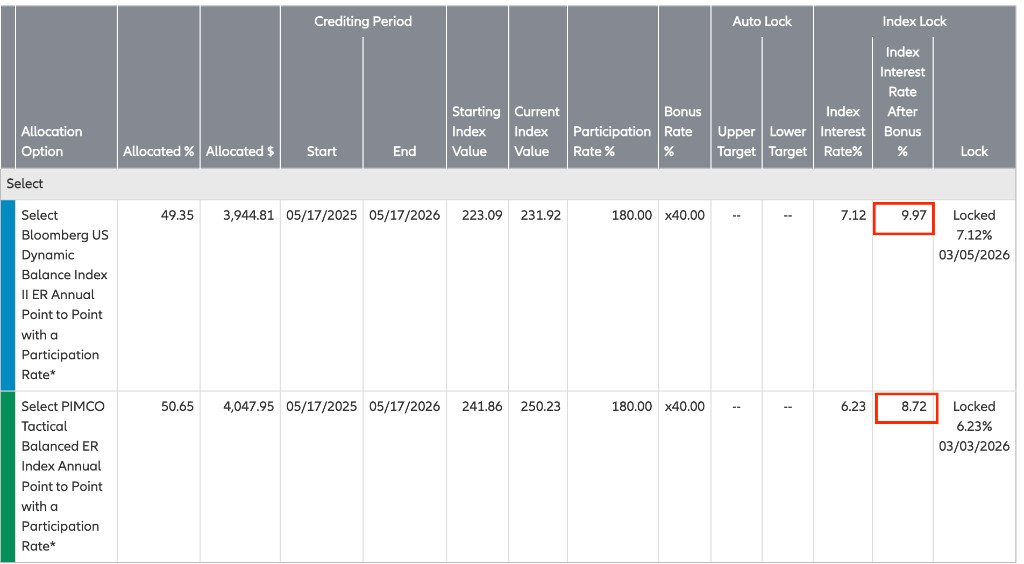
In early March 2026 the market was rolling over. I locked both of my son's segments before the pullback. The crediting period is May 17, 2025 through May 17, 2026. Those rates are already locked for that segment.
| Index | Base Rate | With Bonus and Participation | Locked |
|---|---|---|---|
| Bloomberg US Dynamic Balance II ER | 7.12% | 9.97% | March 5, 2026 |
| PIMCO Tactical Balanced ER | 6.23% | 8.72% | March 3, 2026 |
His cash value is scheduled to be credited those rates when the segment closes, regardless of the index after the lock.
Expert Tip: I lock the rate when the segment is ahead
The rate lock turns a full-year point-to-point into a credit you can hold mid-year. I used it on my son's policy in March 2026, before the pullback. Most illustrations never show that choice.
—Brad Cummins, Insurance Geek Founder
Conclusion
If the goal is cash value and insurability for a child, the design is the premium you can actually finish and a death benefit that keeps the policy out of modified endowment contract status. Our agents see policies started with a number from someone else's illustration, then underfunded. The income figures on this page assume the premium is paid.
We illustrate a child or grandchild at the premium you can keep paying, and we show what happens if that premium stops. That ledger is the decision.
Frequently Asked Questions
Kids IUL is design and funding. Get a realistic illustration and we’ll walk it line-by-line.
An IUL only works when it is custom-built for your goals—the right carrier, premium schedule, and death-benefit structure determine whether you get usable cash value or a policy that stalls. We design around your timeline, tax bracket, and access needs, not an off-the-shelf illustration. See what yours looks like from carriers that fit this strategy.
About Brad Cummins

Brad Cummins is the founder of Insurance Geek and primary author of its educational content. Licensed since 2004, he brings over 21 years of experience structuring life insurance and IUL strategies for clients nationwide.
Fact checked by Ryan Wood

Ryan Wood is a licensed insurance professional and contributing advisor at Insurance Geek, serving as a fact checker and technical reviewer for life insurance and annuity content. First licensed in 2013, he brings more than 12 years of experience and holds licenses in over 40 U.S. states.