

Our editorial team follows strict guidelines to ensure accuracy and objectivity. Learn more about our process.
Most homeowners pay more than they should — not because they chose the wrong policy, but because they never asked which discounts apply to them. Carriers don't volunteer this information at renewal. The discounts exist on every policy; they just require someone to look.
The average homeowner qualifies for five or more separate discount categories. Stack enough of them and you can reduce a $2,400 annual premium by $400–$700 without changing a single coverage limit. But the specific credits available — and how much each is worth — vary by carrier. That's the catch: the carrier with the best advertised discount rate isn't always the carrier with the lowest net premium after discounts are applied to your specific home.
As an independent agency working with multiple top carriers in your state, we can run your home's full discount profile across carriers side by side — not just quote one and hope for the best.
Key Takeaways
- Bundling home and auto with the same carrier is the largest single discount most homeowners can claim — often 15–25% off the home premium alone.
- Security system discounts range from 2–15% depending on the carrier and whether monitoring is central station or smart-device only.
- Claims-free history discounts typically require 3–5 years without a filed claim and can reduce premiums by 5–10%.
- Impact-resistant roofing can earn credits of 10–30% in hail-prone states — one of the highest-value single upgrades for premium savings.
- Paying annually instead of monthly saves most homeowners 3–8% on the policy cost.
- Carriers apply discounts differently; the only way to know which combination produces the lowest net premium is to compare across carriers.
Bundling Home and Auto Insurance
Bundling — combining your homeowners and auto insurance with the same carrier — is the most valuable discount available to most homeowners. Carriers reward multi-policy customers because they're cheaper to retain and statistically lower-risk. The discount typically applies to both policies, not just one.
The range is wide: bundling discounts run from 10% to 25% depending on the carrier. On a $2,400 home premium, that's $240–$600 per year. Before assuming your current bundle is competitive, it's worth checking whether a different carrier combination would net you more savings across both policies than your current single-carrier arrangement.
Already have a policy? See if you're paying too much.
Share your current declarations page — we'll compare it against multiple top carriers and tell you exactly where you stand.
Don't have time to run a quote? Just send us your policy
Share your current policy declarations pages with us in two clicks. Takes about 30 seconds. We'll review your coverage, find gaps, and compare our carriers to your current policy.
Connect your policy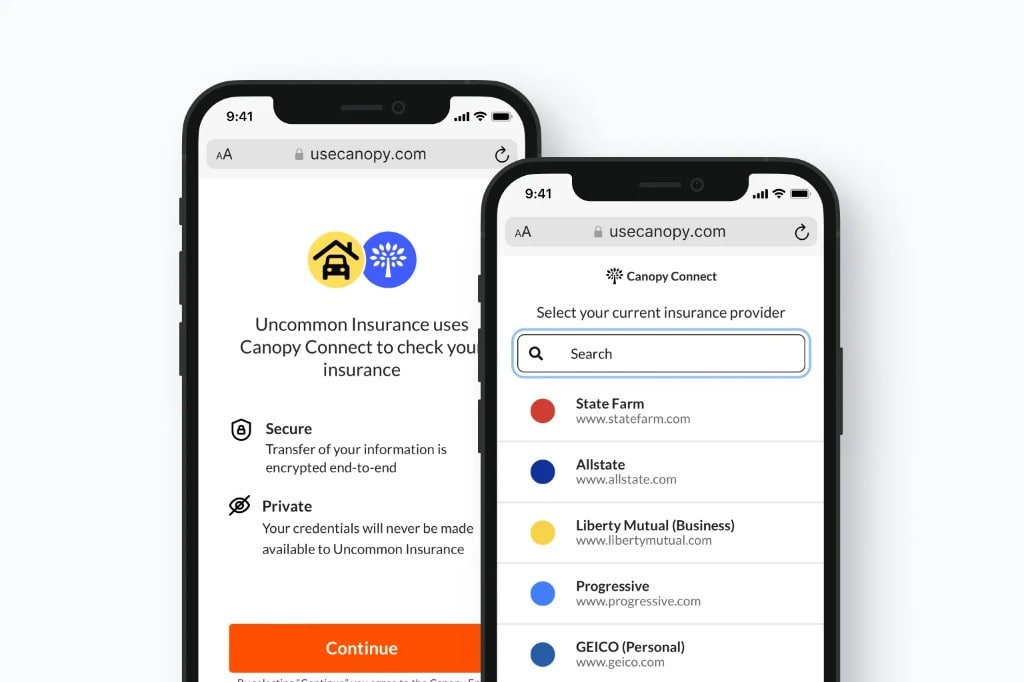
Security System and Alarm Discounts
Carriers discount for protective devices because they reduce the probability and severity of a claim. The credits break down by device type.
Burglar alarm discounts apply when you have a monitored security system. Central station monitoring — where a third-party dispatch center gets notified and contacts emergency services — typically earns a larger credit than a local alarm that only sounds in the home. Most carriers credit 2–8% for monitored burglar systems.
Smoke detector and fire alarm discounts follow the same logic. Standalone battery smoke detectors earn a small credit on most policies. Hard-wired interconnected smoke alarms earn more. A professionally monitored fire alarm system — one that alerts the fire department directly — earns the highest credit in this category, often 5–10%.
Smart home device credits are offered by a growing number of carriers for connected leak detectors, smart smoke alarms, and video doorbells. These vary significantly by carrier and are worth asking about directly.
Impact-Resistant Roof Discount
The roof is the single largest driver of weather-related home insurance claims. Carriers in hail-prone states — Ohio, Texas, Colorado, Kansas — offer meaningful credits for roofs rated Class 3 or Class 4 impact-resistant under UL 2218 testing standards.
A Class 4 rated roof can earn a 10–30% premium discount depending on the carrier and your state. For homeowners in those markets, a new roof upgrade often pays back through premium savings within five to seven years in addition to reducing out-of-pocket exposure after a hailstorm.
If your roof was replaced in the last five years, verify that your carrier has it documented and is applying the correct credit. It's one of the most commonly missed discounts on renewal.
Claims-Free Discount
Carriers reward policyholders who haven't filed claims. The credit typically kicks in after three to five consecutive claim-free years and can reduce premiums by 5–10%. Some carriers call this a "loyalty" credit; others break it into separate claims-free and tenure categories.
One thing to understand: filing a small claim eliminates this discount and typically triggers a surcharge on top of that. Before filing a claim for damage that costs $1,200 to repair, it's worth calculating whether the loss of your claims-free discount — across multiple renewal years — exceeds what the claim would pay out. On smaller claims, the math often favors paying out of pocket.
Loyalty and Tenure Discount
Staying with the same carrier for multiple years earns a tenure discount at most companies. This is distinct from the claims-free credit. Some carriers begin applying it after three years; others after five or ten. The typical range is 5–10%.
The counterintuitive problem with loyalty discounts: they can make it feel expensive to switch, even when a competing carrier's base rate would result in a lower net premium after all discounts are applied. A loyalty credit at Carrier A doesn't mean you're paying less than you would at Carrier B — it means you're paying less than you would at Carrier A without it.
New Home and Recently Purchased Home Discount
Newly constructed homes earn significant discounts at most carriers because newer construction meets current building codes, uses modern materials, and presents lower risk of electrical, plumbing, and structural claims. Credits for homes under five years old can reach 15–20%.
Homeowners who recently purchased a home — even an existing one — may qualify for a new-customer discount at some carriers. If you bought within the past 12 months and haven't yet compared home insurance, that's the right time: new-customer incentives are real and carriers won't volunteer them unless you're actually shopping.
Paid-in-Full and Paperless Discounts
Paying your annual premium in a single payment instead of monthly installments saves most homeowners 3–8%. It also eliminates installment fees, which can add $60–$100 per year on their own.
Paperless billing and autopay enrollment earn smaller credits — typically 1–3% — but they stack with other discounts and require no changes to coverage or property.
Expert Tip: The discount stack most agents skip
The discount most people miss isn't a single credit — it's the combination. Bundling, claims-free, paid-in-full, and a monitored alarm can stack to 30–40% off list premium at the right carrier. The problem is those credits apply differently at every company. I run homeowners quotes across multiple carriers specifically to find which one produces the lowest net premium after all applicable discounts — not just the best headline rate.
—Brad Cummins, Insurance Geek Founder
HOA and Gated Community Discounts
Homeowner associations maintain community standards that reduce carrier risk — maintained landscaping, enforced parking, common area upkeep. Some carriers credit HOA membership directly. Gated community discounts are available at certain carriers for homes where controlled access reduces the probability of theft or vandalism claims.
These credits are smaller — typically 2–5% — but they require no action on your part. If you live in an HOA community and your current carrier hasn't applied this credit, it's worth asking at your next renewal.
Non-Smoker Discount
Some carriers offer a small credit for homes where no occupants smoke. The discount reflects the statistical relationship between smoking and residential fire risk. It's not universal across carriers, but for qualifying households it typically adds 3–5% to the overall discount stack.
Retired Homeowner Discount
Retired homeowners who are present in the home significantly more than working-age occupants present lower risk for undetected claims — a burst pipe noticed immediately versus discovered three days later. Several major carriers credit this with a 5–10% reduction.
If you've recently retired and haven't updated your insurance profile, contact your carrier. The discount may not be automatically applied at renewal.
What Can Disqualify You From Discounts
Discount eligibility isn't guaranteed. Carriers look at the full risk profile before applying credits.
A low credit score affects home insurance pricing in most states. Carriers that use credit-based insurance scores assign credits and surcharges based on financial history — not as a judgment on character, but because it correlates with claim frequency in actuarial data.
Prior claims history matters regardless of carrier. A home with two or more claims in the past five years will see surcharges that offset most available discounts. That's true even if you've switched carriers — claims history follows the address, not just the policyholder.
High-risk location factors — flood zones, wildfire interface areas, high-crime zip codes — limit which credits apply. A home in a coastal county with hurricane exposure may not qualify for the same discount stack as an identical home in a lower-risk zip.
Deferred maintenance disqualifies some credits. A monitored alarm that's inoperative, a roof past its useful life, or documented structural issues can trigger underwriting exclusions that override discount eligibility.
Don't have time to run a quote? Just send us your policy
Share your current policy declarations pages with us in two clicks. Takes about 30 seconds. We'll review your coverage, find gaps, and compare our carriers to your current policy.
Connect your policyDiscount stacking only matters if underlying rates are competitive to begin with. When your profile is stable, it is often worth checking whether another carrier applies the same credits more aggressively for your home. See home insurance rates from multiple carriers with Insurance Geek and we can map which discounts actually move your number.
FAQ
About Brad Cummins

Brad Cummins is the founder of Insurance Geek and primary author of its educational content. Licensed since 2004, he brings over 21 years of experience structuring life insurance and IUL strategies for clients nationwide.
Fact checked by Brianna Baiocco

Brianna Baiocco runs P&C operations at Insurance Geek and fact-checks property and casualty content. Licensed since 2009, she brings over 16 years of experience in auto, home, renters, and commercial insurance.