Our editorial team follows strict guidelines to ensure accuracy and objectivity. Learn more about our process.
Most drivers are paying more for car insurance than they need to — not because cheaper coverage doesn't exist, but because they haven't asked about discounts they already qualify for. Bundling, safe driver credits, usage-based programs, pay-in-full savings, and vehicle safety features can each knock 5–25% off your premium, and they stack. The problem is that carriers don't always apply every eligible discount automatically. You have to know what exists and ask for it. This page covers every major car insurance discount, what it's worth, and who qualifies.
Key Takeaways
- Most drivers qualify for at least three or four discounts and don't know it — bundling alone can save up to 25%
- Usage-based insurance programs like State Farm's Drive Safe & Save can reduce premiums by up to 30–50% for low-risk drivers
- Paying your full premium upfront instead of monthly can save up to 15% at some carriers
- Good student, military, and occupational discounts are available but rarely advertised — you have to ask
- Carriers cap total discount stacking, so a dozen small discounts may hit a ceiling of 40–50% depending on the company
- A licensed agent can review your current policy and identify credits that aren't being applied
Bundling: Multi-Policy Discount
Bundling home, auto, or renters is the single largest discount most drivers can get. When you carry auto insurance and at least one other policy — homeowners, renters, or life insurance — with the same carrier or through the same agency, you qualify for a multi-policy discount. Savings typically range from 10–25% on the auto premium, and some carriers extend the discount to the other policy as well.
This is the first thing I check when reviewing someone's current coverage. If you're carrying auto with one company and home or renters with another, you're almost certainly leaving money on the table. Bundling through an independent agency lets you compare bundled packages across multiple top carriers in your state rather than being locked into one company's pricing.
Multi-Car Discount
Insuring more than one vehicle on the same policy triggers a multi-car discount at most carriers. State Farm and GEICO offer up to 20–25% for multi-car households. If you and a spouse each have a vehicle, or if you're insuring a teenager's car alongside yours, this discount applies automatically at most companies — but it's worth confirming it's on your policy.
Usage-Based Insurance (UBI) Programs
Usage-based programs track your actual driving behavior through a phone app or Bluetooth device and adjust your rate based on what the data shows. If you're a low-mileage, low-risk driver, these programs can produce significant savings.
State Farm's Drive Safe & Save can lower premiums by up to 30%, and some drivers see reductions as high as 50%. The program doesn't penalize high-mileage drivers as heavily as competitors. Nationwide's SmartRide offers up to 40% but takes four to six months of tracking before the discount locks in. Liberty Mutual's RightTrack caps at around 30% but locks in after just 90 days.
State Farm and Nationwide also give a 10% enrollment discount just for signing up for their UBI program before any driving data is collected. Liberty Mutual does not offer an enrollment discount.
If you drive fewer than 10,000 miles per year and you're a cautious driver, UBI is one of the easiest ways to reduce your premium significantly. If you drive aggressively or log high miles in stop-and-go traffic, the data may not work in your favor.
Pay-in-Full Discount
Paying your entire six-month or annual premium upfront instead of monthly can save up to 15% at certain carriers. The savings come from the carrier avoiding billing costs and reducing the risk of missed payments. It's a larger one-time expense, but you eliminate monthly payment processing fees and reduce your total annual cost.
Not every carrier offers this, and the percentage varies. Ask your agent what the pay-in-full savings would be on your specific policy before your next renewal.
Good Driver and Safe Driver Discounts
If you've maintained a clean driving record — no at-fault accidents, no moving violations — for three to five years, most carriers offer a good driver discount. Liberty Mutual, State Farm, Progressive, and USAA all have versions of this credit.
GEICO and Allstate separate "safe driver" and "good driver" into two distinct discounts, which means you could qualify for both. The combined savings can be meaningful, but you have to verify that both are being applied to your policy.
Vehicle Safety and Anti-Theft Discounts
Carriers reward vehicles equipped with safety features and anti-theft technology. Anti-lock brakes, daytime running lights, lane departure warning, automatic emergency braking, and a full airbag system can each contribute to a safety discount — up to 40% at some carriers when multiple features are present. Those discounts sit on top of the coverage package you choose (liability, collision, comprehensive, and add-ons). For how each coverage type works, see our auto insurance coverages overview.
Anti-theft discounts apply when your vehicle has a factory alarm system, GPS tracking, or VIN etching on the windshield. GPS tracking helps authorities recover stolen vehicles quickly, and VIN etching makes a stolen car harder to resell — both reduce the carrier's risk, which reduces your premium.
If you drive a newer vehicle with advanced driver-assistance features, make sure your carrier knows exactly what's installed. Some of these discounts aren't applied automatically — they require you to confirm the equipment on your policy.
We pull your declarations page, then price it with our carriers
You connect your existing insurance account through our secure Canopy link. That imports your declarations page—dwelling limit, deductibles, endorsements—not a stripped-down quote form. We use that snapshot to quote the same coverage stack with our appointed carriers, call out where you’re underinsured, and show whether another carrier beats your renewal for equivalent protection.
Don't have time to run a quote? Just send us your policy
Share your current policy declarations pages with us in two clicks. Takes about 30 seconds. We'll review your coverage, find gaps, and compare our carriers to your current policy.
Connect your policy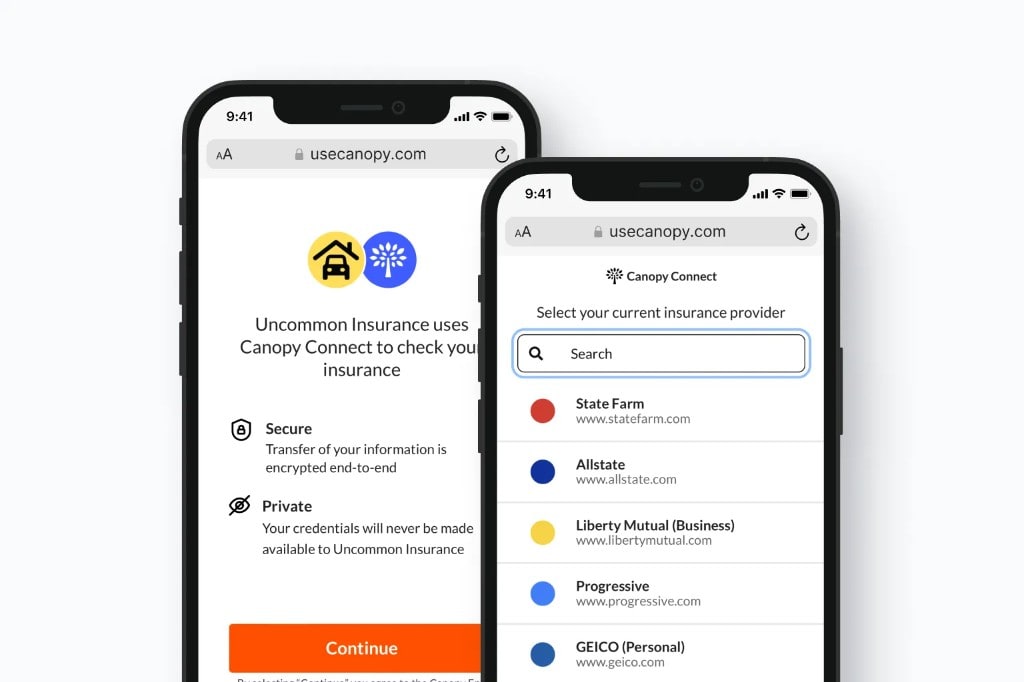
New Car Discount
Vehicles that are new or only a few years old often qualify for a discount of up to 15%. Carriers view newer vehicles as more reliable and better equipped with safety technology, which lowers their claims risk. This discount typically phases out once the vehicle is three to five years old, depending on the carrier.
Good Student Discount
Students aged 16–25 who maintain at least a B average (3.0 GPA) in high school or college qualify for a good student discount at most major carriers. This is one of the most commonly missed discounts for families with young drivers on their policy. Adding a teenager to a policy is expensive — the good student discount helps offset that cost.
You'll typically need to provide a report card or transcript to your carrier once or twice a year to maintain eligibility.
Defensive Driving Course Discount
Drivers over 50 can often qualify for an additional discount by completing an approved defensive driving course. The course covers updated traffic laws, hazard awareness, and techniques for compensating for age-related changes in reaction time and vision. The discount varies by carrier and state but is worth asking about at renewal — especially since several states mandate that carriers offer it.
Younger drivers generally don't qualify for this specific discount, though some states allow a separate discount for completing a state-approved driver education course.
Occupational and Military Discounts
Military personnel — active duty, reserves, and veterans — qualify for auto insurance discounts at GEICO, USAA, and Armed Forces Insurance (AFI), among others. These are sometimes listed as "membership discounts" and can be substantial.
Beyond military, many carriers offer occupational discounts for federal employees, engineers, nurses, teachers, pilots, and other professions. These discounts aren't advertised broadly, so most people don't know they exist. Ask your agent whether your occupation qualifies — the answer may surprise you.
EFT and Paperless Discounts
Setting up automatic electronic payments (EFT) from your bank account earns a small discount at some carriers. Going paperless — receiving bills and documents electronically instead of by mail — can add another small credit. Neither of these is large on its own, but they stack with other discounts and cost you nothing to activate.
Discount Stacking and Cap Limits
Here's what most people don't realize: carriers cap total discount stacking. You might qualify for a dozen discounts that add up to 55% on paper, but the carrier's maximum combined discount might be 40%. That cap varies by company and isn't always disclosed upfront. Your starting premium before discounts still drives the math — for typical ranges by state, see average car insurance cost.
This is why comparing across carriers matters. One company's discount cap might limit you to 35% total savings while another carrier's structure lets you capture 45% across the same set of discounts. An independent agent comparing multiple top carriers in your state can identify which company's discount structure gives you the most real savings — not just the most discounts on paper.
How to Make Sure You're Getting Every Discount
Knowing what discounts exist is only half the equation — whether your current policy is actually applying them is the other half. Discounts can fall off at renewal, new eligibility can go unclaimed, and some credits require you to actively request them.
A licensed agent can pull up your current policy, compare it against your actual eligibility, and identify credits you're missing. Whether that's a bundling discount you haven't claimed, a good-driver credit that wasn't applied after your last clean year, or a vehicle safety feature the carrier doesn't have on file — the savings are already available. You just have to ask.
See if you're missing discounts on your current policy
Upload your current policy or connect your carrier — we'll review your coverage and identify savings you may be leaving on the table.
Don't have time to run a quote? Just send us your policy
Share your current policy declarations pages with us in two clicks. Takes about 30 seconds. We'll review your coverage, find gaps, and compare our carriers to your current policy.
Connect your policyFAQ
About Brad Cummins

Brad Cummins is the founder of Insurance Geek and primary author of its educational content. Licensed since 2004, he brings over 21 years of experience structuring life insurance and IUL strategies for clients nationwide.
Fact checked by Brianna Baiocco

Brianna Baiocco runs P&C operations at Insurance Geek and fact-checks property and casualty content. Licensed since 2009, she brings over 16 years of experience in auto, home, renters, and commercial insurance.